No surprises, no jargon, no awkward moments. Here is a friendly walkthrough of everything that happens — from the moment you arrive to the day your brain starts working better.
There is almost nothing you need to do to prepare, which is one of the things people love about neurofeedback. Just a few simple tips recommended by the ISNR to help us get the best recording possible:
That is really it. No fasting, no special preparation, no homework. Just show up as yourself.
This is the part most people are curious (and maybe a tiny bit nervous) about. Let us walk through it moment by moment so there are zero surprises.
We will greet you, show you where everything is, and have a brief conversation about what brought you in. Our licensed clinicians make this feel more like chatting with someone who genuinely wants to help. We will ask about your goals, your symptoms, and anything else that helps us understand your experience through a clinical intake process.
Next, we place a comfortable cap on your head with 19 sensors positioned following the international 10-20 system. We apply a small amount of conductive gel to each sensor to help pick up the faint electrical signals your brain naturally produces. It is not painful, not weird, and you will not feel any electricity at all.
Once everything is connected and we are getting a clean signal, you just sit still and relax. We may ask you to shift between states so we can see how your brain responds, consistent with standard qEEG recording protocols. The sensors are quietly reading the whole time through the NewMind platform. Most people say this part is surprisingly peaceful.
That is it for the recording. We gently remove the cap, offer you a towel for any gel residue in your hair, and you are free to go about your day. The hard part (sitting still for 30 minutes) is over.
After your recording, the data goes through a detailed analysis via the NewMind system. Your brainwave patterns are compared to a large normative database of healthy brains matched to your age and gender. This comparison produces what we call a brain map — a series of colorful, topographic images of your brain from different angles.
We will sit down together and walk through every finding in plain, everyday language. You do not need any science background to understand your results — we connect the dots between what the map shows and the symptoms or challenges you have been experiencing.
Based on your brain map results, we create a neurofeedback training protocol designed specifically for your brain using Dr. Soutar's clinical methodology. This is not a one-size-fits-all program. The areas we train, the brainwave frequencies we target, and the approach we use are all customized through the NewMind system to what your map tells us.
We will explain exactly what the plan involves, how many sessions we recommend based on clinical research guidelines, and what kind of improvements you can realistically expect. Our Rivers Edge team wants you to feel confident and informed before you begin.
Here is the part that surprises most people: neurofeedback training sessions are genuinely enjoyable. Seriously.
At the start of each session, we place a few small sensors on specific locations on your scalp based on your personalized protocol and BCIA clinical standards. These are attached with a small dab of conductive paste — no needles, no discomfort. Setup follows the standard EEG electrode placement protocol and takes just a few minutes.
Once the sensors are in place, you settle into a comfortable chair and watch a movie, a show, or play a simple video game. The content responds to your brainwave activity in real time through the NewMind training platform — a process rooted in operant conditioning.
When your brain produces the patterns we are training for — maybe calmer activity in an overactive area, or more focus in an underactive one — the movie plays clearly. When your brain drifts away from those patterns, the screen dims slightly. Your brain naturally wants the reward, so it starts adjusting itself through neuroplasticity — the same mechanism studied by the National Institute of Mental Health.
You do not need to concentrate, meditate, or force anything to happen. In fact, the less you try to control it, the better it works, as the ISNR explains. Most people tell us their neurofeedback session is the most relaxing part of their week. Kids love it because it feels like they are just watching a movie — the AAP recognizes this child-friendly approach as a key advantage.
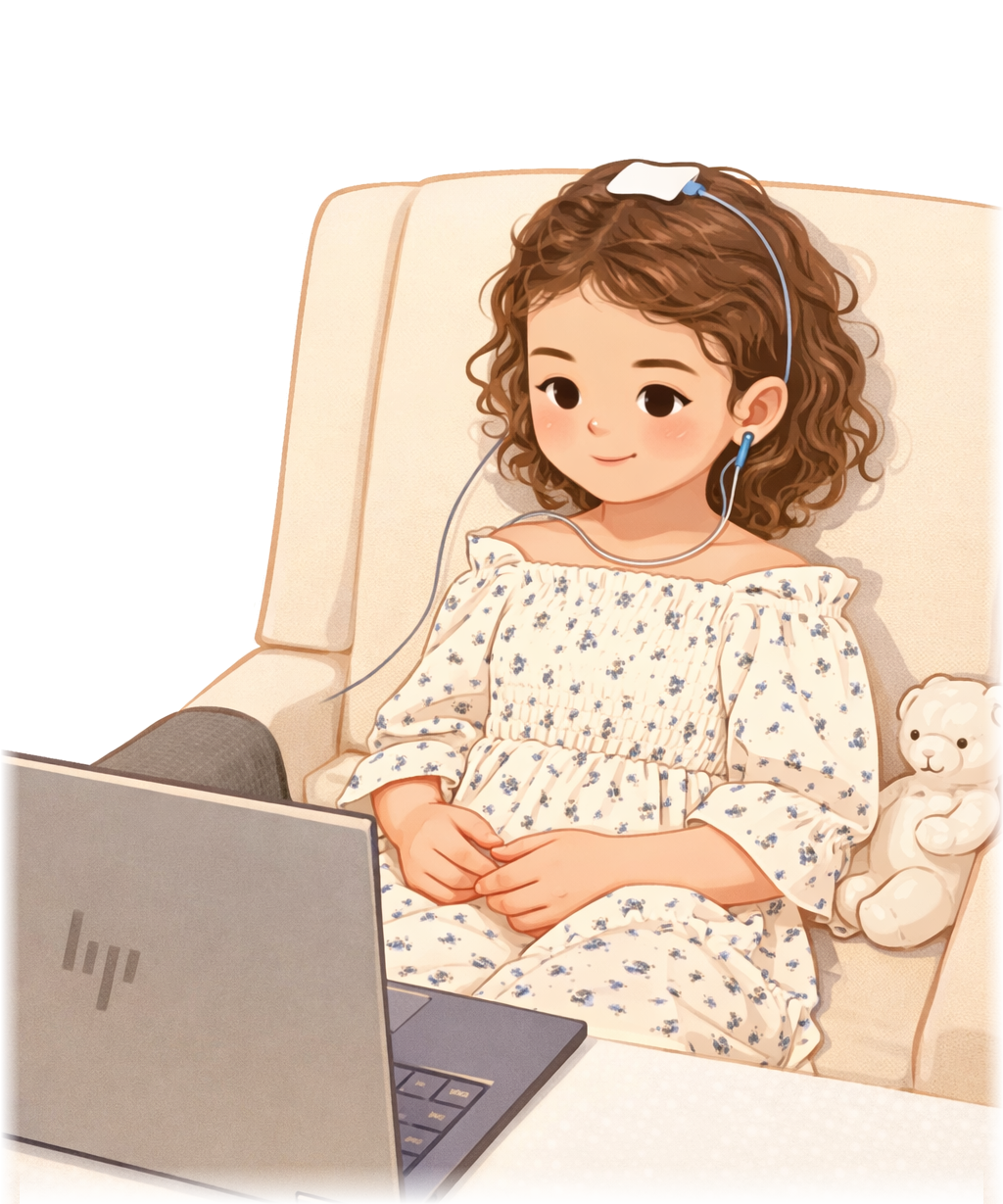
We remove the sensors, you wipe off any paste residue, and you go about your day. There is no recovery time, no restrictions, and nothing you need to avoid afterward. Research confirms that neurofeedback has an excellent safety profile. Some people feel noticeably calmer or more focused right after a session — changes consistent with what the BCIA reports in clinical literature.
Neurofeedback is a learning process for your brain, and like any kind of learning, results build over time through neuroplasticity. Some people notice shifts after just a handful of sessions — better sleep, less irritability, improved focus. For most, the more significant and lasting changes start to show up in the 10 to 20 session range, consistent with ISNR clinical guidelines.
A typical full course of training is between 20 and 40 sessions, but every brain is different. We track your progress throughout using the NewMind dashboard and adjust your protocol as your brain changes. Research supports this individualized approach.
For families who live farther away or have packed schedules, we also offer clinician-guided home training. You use professional-grade equipment in the comfort of your own home while we monitor your sessions remotely through the NewMind real-time dashboard. It is the same quality of neurofeedback training, just without the drive.
We hear these questions every single day, and they are completely valid. Let us put your mind at ease.
Not at all. The sensors sit gently on the surface of your scalp. They only read your brain's natural electrical activity, exactly like a standard clinical EEG — they do not send anything in. The BCIA confirms there are no shocks, no zaps, no tingling. Many people find the experience so comfortable they almost doze off.
Honestly, the scariest part is usually the anticipation beforehand. Once you are in the chair and we walk you through everything, people almost always say the same thing: "That is it?" There are no enclosed spaces, no loud machines, and no dark rooms. It is just you, a comfortable chair, and a screen.
This is not like an MRI at all. You sit in a regular chair in an open, well-lit room. The sensor cap is lightweight and sits on top of your head — it does not cover your face, ears, or eyes. There is nothing enclosed about the experience.
Neurofeedback has decades of clinical research behind it and has helped people with a wide range of challenges. That said, every brain is different. The $99 brain map is designed to be a low-risk starting point — it gives us (and you) objective data consistent with ISNR standards about whether neurofeedback is likely to help your specific situation.
The vast majority of people feel great after sessions — calmer, more focused, or simply relaxed. Occasionally, someone might feel a little tired or slightly "off" after the first session or two as their brain adjusts. These mild effects are temporary and typically resolve quickly. We monitor your response closely and adjust as needed.
Absolutely. Neurofeedback is non-invasive and has been used safely with children for decades, as recognized by the American Academy of Pediatrics. There is no medication involved and no lasting side effects. Research confirms that kids ages 6 and up regularly do brain mapping and training, and most look forward to their sessions.
Your $99 Brain Map is where everything begins. Thirty painless minutes, a clear picture of how your brain is working using peer-reviewed methodology, and a personalized plan for what comes next — all guided by experienced clinicians.